Boundary Survey for Land Along a Curving Public Road
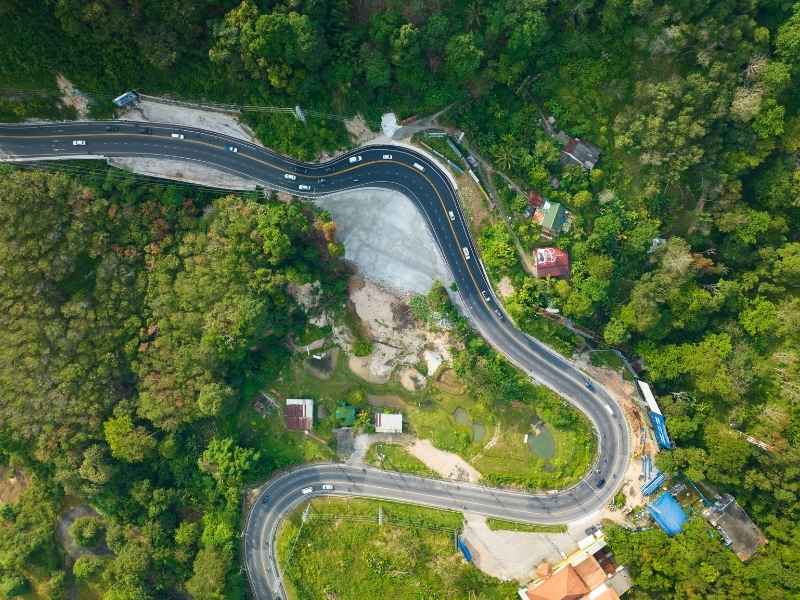
A curving road can hide a lot of truth about where your land really begins. A boundary survey finds that truth. It shows you the real line between your land and the road, even when the road bends and twists.
This matters more than most people think. On a curved road, the pavement, the shoulder, and the ditch can all look like the edge of your land. They often are not.
Confirming Where the Property Meets a Curving Road Right-of-Way
A boundary survey shows exactly where your land meets the public road. On a straight road, this is often easy to guess. On a curved road, it gets harder.
Many people assume the edge of the pavement marks their land. It usually does not. The road often sits inside a strip of land called the right-of-way. This strip can be wider than the road itself. Your true property line might sit well behind the ditch or shoulder you see each day.
A survey checks this for you. It uses real measurements instead of guesses based on what the road looks like from your yard.
Reconstructing Curved Frontage From Recorded Plat and Deed Information
Old records hold the key to a curved boundary. Plats and deeds often list numbers for a curve. These can include its radius, arc length, and chord distance. A surveyor uses these numbers to rebuild the true path of your property line.
This work takes skill. A curve on paper does not always match a curve on the ground today. Roads shift. Pavement gets redone and widened. Ditches move over time. A surveyor checks the old numbers against the site today to find where your real boundary sits now.
Getting this right matters. A boundary rebuilt from solid records gives you a line you can trust, not one based on how the road appears today.
Measuring How Much Road Frontage the Parcel Actually Has
Frontage means the part of your land that touches the road. On a straight road, this is simple to picture. On a curved road, it gets tricky fast.
A curve can make your land look like it has more frontage than it really does. It can also make it look less. Your eyes are not a good tool here. A survey fixes this. It measures the frontage using exact points along the curve.
This number matters more than curiosity. It can shape how you plan a driveway, add a building, or handle future changes near the front of your land.
Comparing Driveways and Roadside Improvements With the Surveyed Frontage
Once a surveyor sets the true curved boundary, they can compare it to what’s already there. This includes driveways, culverts, fences, ditches, and mailboxes near the road.
These features often do not follow the real property line. A fence might sit a few feet into the right-of-way. A driveway might cross onto land you do not actually own. None of this is unusual on curved roads, where the boundary bends in ways that are hard to judge without measurements.
Seeing these features next to the surveyed line gives you a clear picture. You’ll know exactly what sits where, instead of relying on guesswork built up over years.
Using Curved Boundary Data for Future Site and Access Planning
Once you have accurate frontage information, you can use it for real decisions. Planning a new driveway becomes easier when you know exactly where your land starts. Placing a building near the road gets simpler too, since you’re working from real numbers instead of rough estimates.
This kind of planning matters most before construction begins. Fixing a mistake after building starts costs far more than checking the boundary first. Curved frontage data gives you a solid starting point for any project near the road, whether that’s a driveway, a fence, or a new structure.
Frequently Asked Questions
Does the edge of a curved public road mark the property line?
No. The pavement or shoulder does not always match the legal boundary. Recorded and surveyed information should be checked instead.
Can a boundary survey measure frontage along a curved road?
Yes. A survey can set the road-facing limits of your land and calculate the frontage using the curve’s recorded measurements.
Why can curved road frontage be harder to identify than straight frontage?
A curve changes direction along its length. That shift makes the boundary hard to judge by eye, so surveyed measurements are needed for an accurate answer.
Can a survey show where my driveway meets the curved road frontage?
Yes. Visible driveways and other roadside features can be located next to the surveyed boundary when they’re part of the survey.
Should curved road frontage be surveyed before planning a new driveway or entrance?
Yes. Knowing the true frontage and property limits first gives you a more reliable base for planning access near the road.
